
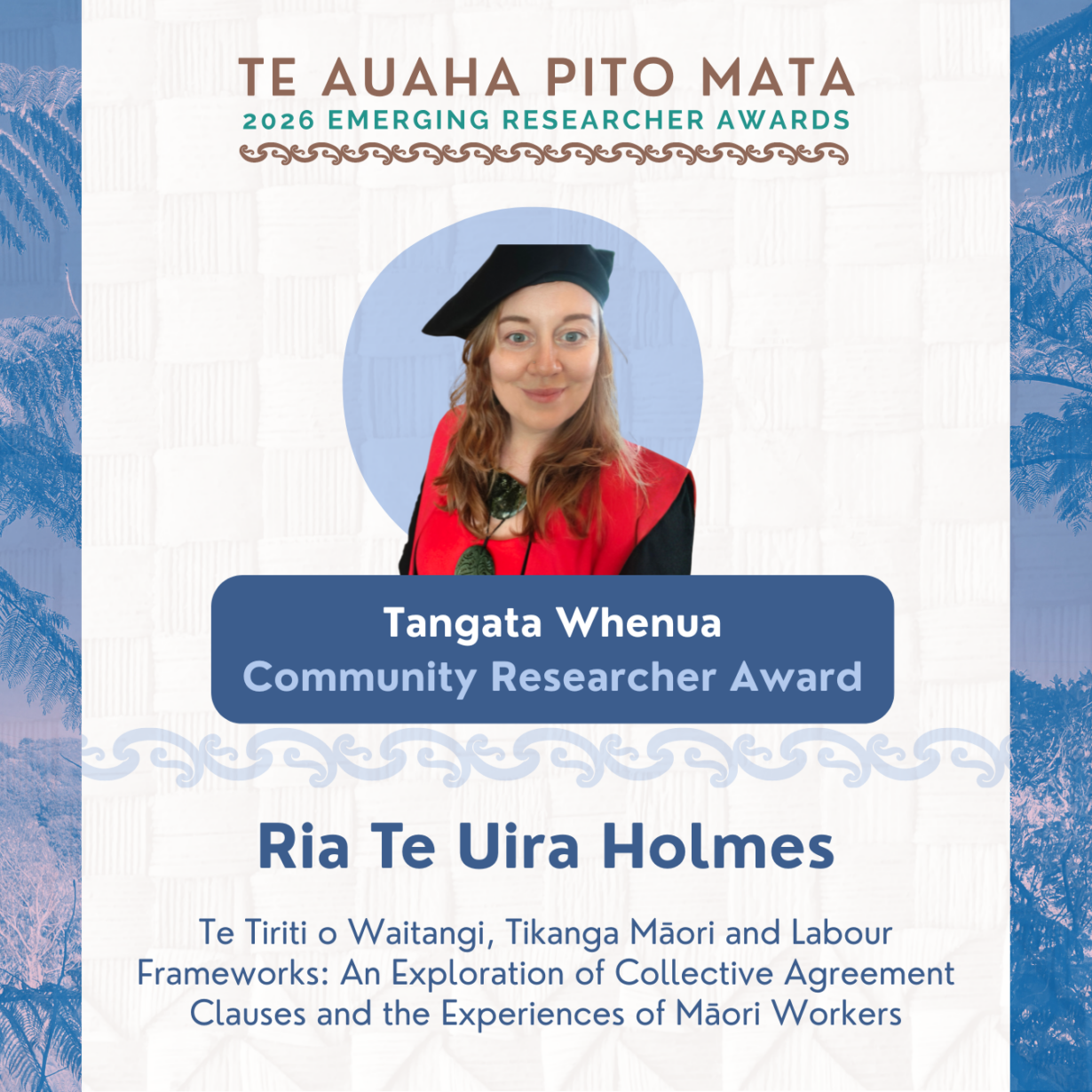
We’re delighted to announce that the winner of our Tangata Whenua Community Researcher Award at the 2026 Te Auaha Pito Mata Emerging Researcher Awards is Ria Te Uira Holmes.
Ria won the award for her doctoral research titled ‘Te Tiriti o Waitangi, Tikanga Māori and Labour Frameworks: An Exploration of Collective Agreement Clauses and the Experiences of Māori Workers.’ It is now available to read via Community Research’s open-access database here!
This mahi is her PhD, completed at Te Herenga Waka Victoria University of Wellington. Ria looked into the obligations that stem from Te Tiriti o Waitangi, the engagement of tikanga Māori in the law, and ultimately Māori workers’ perspectives on collective agreement clauses in their workplace.
“I had the absolute privilege of interviewing and spending time with my kaumātua, who helped really guide my understanding of tikanga Māori as a system of law that is lived from the ground up,” said Ria. “[They] enabled me to engage with the academic discourse on tikanga as a system of law in a different way – in a way that really asserted and recognised tikanga Māori as the first law of Aotearoa.”
Ria also worked alongside the Public Service Association (PSA) union within the research project. With their support, she was able to survey and engage with leaders in the Māori union movement. This also allowed her to speak directly with survey workers across different ministries, and gain an understanding of how they understood and engaged with Te Tiriti o Waitangi, tikanga Māori, te reo Māori and te ao Māori.
“This enabled me to build from worker voice and participation,” Ria continued, “to understand the ways that we can take some immediate steps to improve Māori workers—and actually more broadly all workers—in Aotearoa’s experiences, and how we can look to the future to consider what might appropriate reform look like.”
Her rigorous, courageous, and deeply culturally-grounded research asks how we in Aotearoa can continue to build Te Tiriti and tikanga Māori not only into the fabric of workplace relations, but into the fabric of how we engage and deal with each other.
“It really is built from my whānau and from my community,” said Ria. “The strength of this research is that it’s built through the story of my whānau, and the struggles of my whānau, and really just more generally, the fight for Tiriti justice. It is a community led and community driven project.”