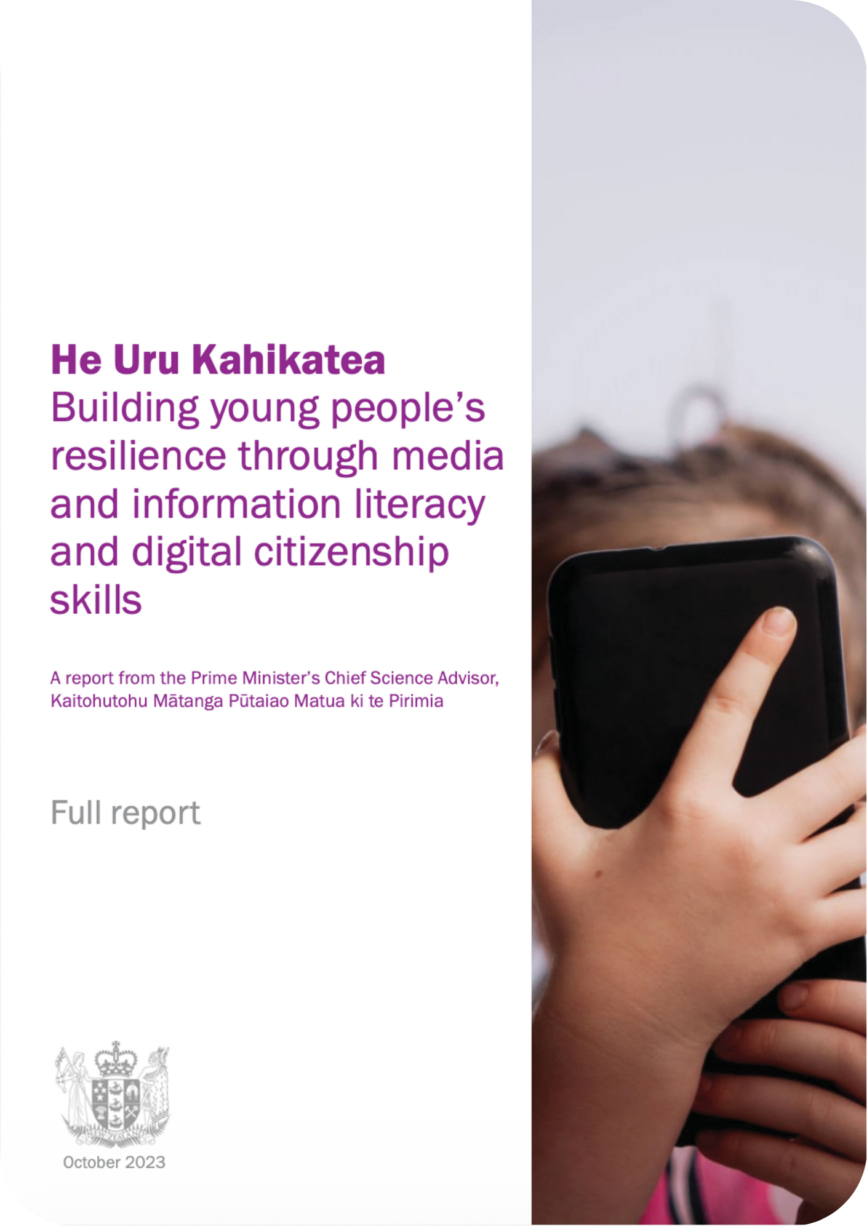
He Uru Kahikatea: Building young people’s resilience through media and information literacy and digital citizenship skills (2023)
Authors: Melinda Webber, Stuart McNaughton, Juliet Gerrard, Susie Meade and Colson Verdonk.
Office of the Prime Minister’s Chief Science Advisor
From harm to harassment: Understanding and combatting online gender-based violence in New Zealand (2024)
Author: Shannon Zhan
Wellington City Council, & Bloomberg Center for Cities at Harvard University
Online misogyny and violent extremism: Understanding the landscape: Summary report (2024)
Te Mana Whakaatu—Classification Office
A summary of literature reflecting the perspectives of young people in Aotearoa on systemic factors affecting their wellbeing (2023)
Authors: Jessica Stubbing, Naomi Simon-Kumar and Sir Peter Gluckman
Koi Tū for Te Hinga Mahara – Mental Health and Welbeing Commission
Safer Online Services and Media Platforms (2021–2024)
Department of Internal Affairs and Ministry for Culture and Heritage
A comprehensive regulatory and evidence review framework that aggregated international regulatory research, multi-stakeholder submissions, and targeted impact assessments to modernize safety standards across digital media and social platforms in Aotearoa.
The World Happiness Report 2026: Happiness and social media (2026)
University of Oxford, Gallup, UN Sustainable Development Solutions Network, and World Happiness Report Editorial Board.
This report examines the complex, global relationship between digital technology habits and human wellbeing across diverse countries—including New Zealand and other English-speaking nations.
Online gaming and wellbeing among Pacific youth: a scoping review (2025)
Authors: Jean M Uasike Allen, Joanna Ting Wai Chu, Carine Umutoniwase, David Taufui Mikato Fa’avae, Lawrence May, Jacoba Matapo, Analosa Veukiso-Ulugia
Journal of the Royal Society of New Zealand
Exploring Digital Vā: A Scoping Review of Conceptualisations of Vā in Digital Spaces (2026)
Authors: Jean M Uasike Allen, Joanna Ting Wai Chu, Carine Umutoniwase, David Taufui Mikato Fa’avae, Lawrence May, Jacoba Matapo, Analosa Veukiso-Ulugia
Journal of the Royal Society of New Zealand
Research Programmes
Te Mana Whakaatu – The Classification Office is an independent Crown entity focused on keeping New Zealanders safe from content harm. As part of its statutory research and information functions, the Office conducts research and produces evidence-based resources to promote media literacy and positive engagement with media content.
The Disinformation Project operated between 2020-2024 as a New Zealand independent research group providing best practice monitoring, research and consulting on disinformation and its impacts in Aotearoa. The resources, tools, and research they released can be accessed on the project website.
* See also: Platform imperialism and disinformation in Aotearoa-New Zealand (2025) by Olivier Jutel and Leon A. Salter, which discusses how The Disinformation Project influenced local politics and shaped public debate.
Netsafe provides a range of support for staying safe online. They also collaborate with leading academic institutions, international organisations, industry experts and community groups to conduct research studies on a broad range of online safety issues.
* Netsafe are a not-for-profit organisation. They receive their core funding from the Ministry of Education and Ministry of Justice. However, Netsafe have also received support for specific projects from industry funders, including Meta, Chorus, Spark, Apple and more.